

Custom pressure vessels and heat exchangers are the heart of safe, efficient operations in industries like oil and gas, petrochemicals, and power generation. Unlike standard parts, these are highly engineered assets built to withstand specific, extreme conditions. For engineers and procurement managers, specifying and sourcing this equipment is a high-stakes task. Navigating ASME codes, material selection, and fabrication standards is complex, and making the right choice is critical for plant safety, compliance, and reliability.
This guide provides an overview of the key factors in custom fabrication. We’ll cover design principles, material selection, quality certifications, and testing to help you source a compliant, long-lasting vessel from a custom pressure vessel manufacturer.
The Foundation: Matching Design to Your Application
The design of a pressure vessel or heat exchanger is dictated entirely by its intended function. Before a single piece of steel is cut, a thorough engineering process must occur to define the operating parameters and, consequently, the physical design.
Defining Process Conditions
The first step is always a deep dive into the process conditions:
- Operating Pressure: The maximum and minimum pressures the vessel will experience.
- Operating Temperature: The full range of temperatures, from startup to shutdown.
- Media: The substance being stored or processed (e.g., natural gas, crude oil, steam, caustic chemicals). This determines corrosion risk.
- Flow Rate: For heat exchangers and process vessels like separators, the volume of media passing through is critical for sizing.
Vessel Shape and Head Type
These process conditions directly influence the vessel’s geometry. While cylindrical vessels are the most common and cost-effective, spherical shapes are structurally more efficient and often used for high-pressure storage.
The head type (the end-caps of the vessel) is also a critical design choice:
- 2:1 ASME Semi-Elliptical Heads: A common choice offering a good balance of strength and cost.
- Dished Heads: Often used for lower-pressure applications.
- Hemispherical Heads: The strongest and most expensive, typically reserved for very high-pressure applications.
At Enermax, our in-house engineering team uses advanced 3D modeling and design software to translate your process data into a detailed fabricated product, ensuring the final design is perfectly optimized for its application, whether it’s a separator, knock-out drum, heat exchanger, or process tower.
Material Selection: The Core of Vessel Integrity
Choosing the right material is a balancing act between mechanical strength, corrosion resistance, and cost. A material that performs well at ambient temperature may fail under cryogenic or high-heat conditions.
- Carbon Steel: The workhorse of the industry. It offers excellent strength and durability at a lower cost, making it ideal for a vast range of applications in the oil and gas and power sectors where internal corrosion is not the primary concern.
- Stainless Steel: The preferred choice when corrosion resistance is paramount. In grades like 304 or 316, stainless steel is ideal for processes involving corrosive chemicals, high-purity substances (food, pharma), or where contamination must be avoided.
- Specialty Alloys: For extreme environments involving high temperatures or highly corrosive media , specialty alloys are required. These materials are more expensive but provide the necessary resistance to ensure safety and a long service life.
An experienced manufacturer will also factor in a “corrosion allowance” during the design phase. This involves adding material thickness beyond what is required for pressure containment, providing a sacrificial layer that extends the vessel’s operational life, especially in demanding environments like those found in Alberta’s energy sector.
Decoding Certifications: The Non-negotiable Standard of Quality
When it comes to pressure vessel fabrication, certifications are not suggestions; they are the law and the primary guarantee of safety and quality. All manufacturers must operate within this framework.
When vetting a custom pressure vessel manufacturer, look for these key certifications, which Enermax proudly maintains:
- ASME Section VIII, Division 1 “U” Stamp: This is the industry’s gold standard. The “U” stamp from the American Society of Mechanical Engineers (ASME) certifies that the manufacturer’s design, fabrication, and inspection processes meet the rigorous requirements for new unfired pressure vessels.
- National Board “R” Stamp: Issued by the National Board of Boiler and Pressure Vessel Inspectors, the “R” stamp authorizes a facility to perform repairs and alterations to pressure-retaining items that were originally constructed to the ASME Code. This is crucial for maintenance, re-rating, and extending the life of your assets.
- CWB Certification: Certification from the Canadian Welding Bureau (CWB) confirms that welders and welding procedures meet the specific standards required for structural steel fabrication, often a key component of packaged systems or vessel-related structural elements.
These certifications are non-negotiable. They are your assurance that the manufacturer has the documented processes, skilled personnel, and quality control program necessary to build equipment that is safe, reliable, and legally compliant.
The Critical Role of Welding
The structural integrity of a pressure vessel is held in its welds. High-quality welding is essential to prevent defects like cracking, porosity, or lack of fusion, which can become catastrophic failure points under pressure.
An elite fabrication shop invests heavily in its welding program, employing certified welders (e.g., CWB and ASME-qualified), and utilizing a combination of advanced and traditional welding processes. At Enermax, our in-house fabrication control ensures that every weld is performed to a specific, pre-approved procedure and meticulously inspected.
In-House Fabrication Advantages
Controlling the entire fabrication process under one roof is a significant advantage. It allows for:
- Tighter Quality Control: A dedicated QA/QC team can oversee every step, from material receiving to final testing.
- Schedule Adherence: Eliminates delays from coordinating multiple third-party vendors.
- Accountability: A single point of responsibility for the entire project.
Ensuring Safety and Performance: A Deep Dive into Testing
Every vessel must be subjected to a battery of tests to verify its integrity before it leaves the shop. These methods fall into two categories: nondestructive examination (NDE) and pressure testing.
Nondestructive Examination (NDE)
NDE methods inspect the vessel for flaws without damaging the material:
- Radiographic Testing (RT): Uses X-rays or gamma rays to inspect weld seams, revealing internal defects like porosity or cracks.
- Ultrasonic Testing (UT): Uses high-frequency sound waves to detect subsurface flaws and measure material thickness.
- Magnetic Particle Testing (MT): Used on ferromagnetic materials (like carbon steel) to find surface and near-surface defects.
- Liquid Penetrant Testing (PT): A liquid dye is applied to the surface to reveal surface defects.
Hydrostatic and Pneumatic Testing
After NDE, the vessel undergoes a proof test. The most common is hydrostatic testing, where the vessel is filled with water and pressurized to a level above its normal operating pressure (typically 1.3 times the Maximum Allowable Working Pressure (MAWP)). This test is a final, definitive verification of the vessel’s structural integrity and leak-tightness. In some cases where water cannot be used, a pneumatic (air) test may be performed with extreme caution.
A manufacturer should offer both internal testing and third-party inspection services to provide a complete, unbiased quality report.
Beyond Vessels: Integrated Heat Exchanger Solutions
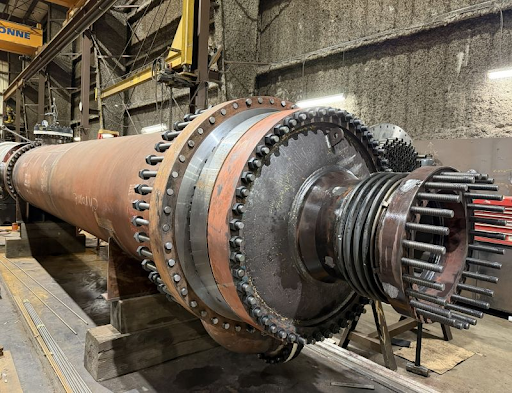
Enermax specializes in the design, fabrication, and repair of shell and tube heat exchangers, the most common type used in industrial processing. We build and service all TEMA types, from simple fixed tubesheet designs to complex floating head and U-tube bundles.
Our capabilities include:
- New Fabrication: Building custom shell and tube exchangers to meet your exact thermal and process requirements.
- Repair and Retubing: Providing critical maintenance services to extend the life of your existing assets, a service underpinned by our “R” stamp certification.
By integrating the same principles of high-quality materials, ASME-compliant welding, and rigorous testing, we ensure our heat exchangers deliver the thermal performance and reliability your process demands.
How to Get a Pressure Vessel or Heat Exchanger Quote
You are now equipped with the key criteria for a high-quality vessel. When you’re ready to request a quote from an ASME manufacturer, having the following information ready will ensure you receive an accurate and timely response:
- Process Data: Pressure, temperature, media, and flow rates.
- Design Requirements: Any known vessel dimensions, orientation, or nozzle specifications.
- Material Preference: Carbon steel, stainless steel, or specific alloys.
- Certification Needs: ASME “U” stamp or other jurisdictional requirements.
- Documentation: The level of documentation required (e.g., material test reports, welding logs, NDE reports).
A true manufacturing partner will not just be an order-taker. They will be a solutions provider who reviews your specifications, asks clarifying questions, and uses their expertise to recommend a design that is safe, compliant, and cost-effective.
Contact Enermax, Your Trusted Custom Pressure Vessel Manufacturer
For decades, Enermax has been a trusted partner for companies across Alberta and Western Canada, delivering custom-fabricated pressure vessels, heat exchangers, and packaged systems built to the highest standards of quality and safety. Our in-house engineering, state-of-the-art facility, and unwavering commitment to quality, backed by our ASME “U” and “R” stamps, make us the ideal choice for your next project.
If you are looking for a fabrication partner who understands the technical demands of your industry, contact our team today. Let’s discuss your project specifications and begin the process of building the equipment your operations can depend on.