

In the intricate landscape of industrial processing, where efficiency, purity, and sustainability are key drivers, certain technologies stand out for their transformative impact. At the core of countless critical operations is a powerful and versatile piece of equipment: the industrial evaporator. These sophisticated systems are the unsung heroes responsible for concentrating solutions, separating liquids, and reclaiming valuable solvents across a vast spectrum of industries. From enhancing the flavor and shelf-life of food products to enabling complex chemical syntheses and promoting environmental stewardship through waste reduction, evaporators are vital to modern manufacturing.
This blog will explore the fundamental principles, designs, and applications of industrial evaporators. More importantly, it will illustrate why these units are classified as pressure vessels and why partnering with an experienced, ASME-certified fabricator like Enermax is a critical decision for ensuring operational safety, uncompromising quality, and long-term performance.
How Industrial Evaporators Function
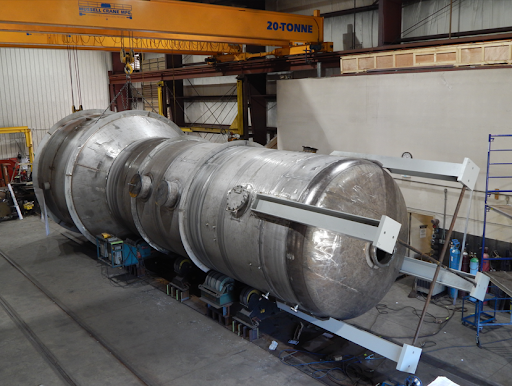
The fundamental principle driving an industrial evaporator is the phase transition of a liquid into a vapor, achieved through precise heat transfer. In a typical process, a feed solution is introduced into the evaporator and heated by a medium such as steam or hot oil. This applied energy raises the temperature of the solution to its boiling point, causing the solvent (most commonly water) to vaporize. The resulting vapor is then separated from the now more concentrated liquid. This concentrate is either the final desired product or an intermediate stream for further processing, while the separated vapor can be condensed and reused or discharged.
While the concept is straightforward, achieving optimal efficiency involves a delicate balance of thermodynamics and fluid dynamics. Factors like heat flux, surface area, operating pressure, and fluid characteristics must be carefully managed. For instance, many processes operate under a vacuum to lower the solution’s boiling point, which protects heat-sensitive products from degradation and reduces energy consumption.
Common Types of Industrial Evaporators
To meet the diverse needs of modern industry, industrial evaporators are engineered in various configurations, each tailored for specific applications, fluid viscosities, and heat sensitivities.
Some of the most prevalent designs include:
- Falling Film Evaporators: Highly effective for heat-sensitive products like dairy, pharmaceuticals, and fruit juices. In this design, the liquid is fed to the top of long, heated tubes and flows downwards as a thin, continuous film. This creates a large surface area for heat transfer, allowing for rapid and gentle evaporation with a short residence time, thus preserving the product’s quality and integrity.
- Forced Circulation Evaporators: The workhorse for processing viscous, scaling, or fouling-prone liquids. A high-velocity pump continuously circulates the liquid through the heat exchanger, creating turbulence that minimizes the buildup of solids on heat transfer surfaces and prevents clogging. This makes them ideal for applications like brine concentration and crystallizer systems.
- Plate Evaporators: Valued for their compact footprint and exceptional thermal efficiency. These units use a series of gasketed plates to create a large, turbulent flow path for both the product and the heating medium. They are easily scalable and simple to clean, making them a popular choice in the food, beverage, and dairy industries.
Crucial Applications Across Industries
The versatility of industrial evaporators makes them indispensable components in a wide array of sectors, driving both production and sustainability goals:
- Oil & Gas: Essential for managing large volumes of produced water from extraction activities, concentrating waste streams for cost-effective disposal, and in various refining processes to separate hydrocarbons.
- Petrochemical: The petrochemical industry heavily relies on evaporators for concentrating chemical solutions, purifying products, and recovering valuable solvents, which improves process economics and reduces environmental impact.
- Food & Beverage: From concentrating tomato paste and fruit juices to producing whey protein powders and instant coffee, evaporators are fundamental for enhancing flavor, increasing solids content, improving shelf life, and reducing shipping volumes.
- Power Generation: In power plants, evaporators are critical for purifying boiler feedwater to prevent scaling and corrosion in turbines, as well as for concentrating cooling tower blowdown to minimize water consumption.
- Water Treatment: At the forefront of environmental solutions, evaporators are used for desalination, industrial wastewater treatment, and achieving Zero Liquid Discharge (ZLD) by concentrating waste streams to a solid, drastically reducing disposal costs and environmental liability.
The Critical Link Between Evaporators and Pressure Vessels
A crucial and often overlooked aspect of industrial evaporators is that they are, by their very design and function, pressure vessels. They are engineered to operate safely and effectively within a specific envelope of internal pressure (or vacuum) and temperature. This classification is not trivial; it places them under rigorous safety and construction standards to prevent catastrophic failures like leaks or ruptures, which can lead to severe safety hazards, environmental damage, and crippling financial losses from downtime.
To ensure the safety and structural integrity of these vital assets, adherence to globally recognized standards is non-negotiable. The American Society of Mechanical Engineers (ASME) Boiler and Pressure Vessel Code (BPVC) is the definitive standard for the design, fabrication, inspection, and testing of pressure vessels. An ASME certification mark on a piece of equipment is a guarantee that its manufacturer has undergone rigorous audits and maintains the highest level of quality control. It signifies that the evaporator has been built to withstand its specified operating conditions safely and reliably for its entire service life.
Enermax’s Expertise in ASME-Certified Fabrication
At Enermax, we have built our reputation on exceptional engineering and fabrication of custom industrial evaporators and pressure vessels. As an ASME “U” and “S” certified and National Board “R” certified facility, we provide our clients with the peace of mind that comes from knowing their equipment is built to the highest possible standards of safety and quality.
Our core advantages include:
- Unwavering Commitment to ASME Standards: Our certifications are the foundation of our quality management system, ensuring every product we deliver is safe, reliable, and fully compliant.
- Material Flexibility and Expertise: We possess the deep expertise to work with a wide range of materials, from carbon and stainless steel to specialized alloys, ensuring your evaporator has optimal corrosion resistance and performance for its intended service.
- Agile and Responsive Production: We understand that project timelines are critical. Our streamlined processes and dedicated team are structured to deliver custom-fabricated, high-quality products with industry-leading turnaround times.
- Proudly Made in Canada Quality: All Enermax products are fabricated in Canada, adhering to stringent manufacturing and labor standards. This ensures superior craftsmanship, reliable supply chains, and a final product you can trust.
Contact Enermax for evaporators, pressure vessels, and more today
Choosing the right fabrication partner is a decision that impacts the safety, efficiency, and profitability of your entire operation. With a proven track record, a deep commitment to quality, and the rigorous discipline of our ASME certifications, Enermax is the ideal partner for your custom industrial evaporator and pressure vessel needs.
Contact our team of experts today to start a conversation about your project, discuss your unique processing challenges, and discover how we can deliver a solution engineered for excellence.